Showing posts with label Psalm 18. Show all posts

Sunday, 23 September 2012

Repainting

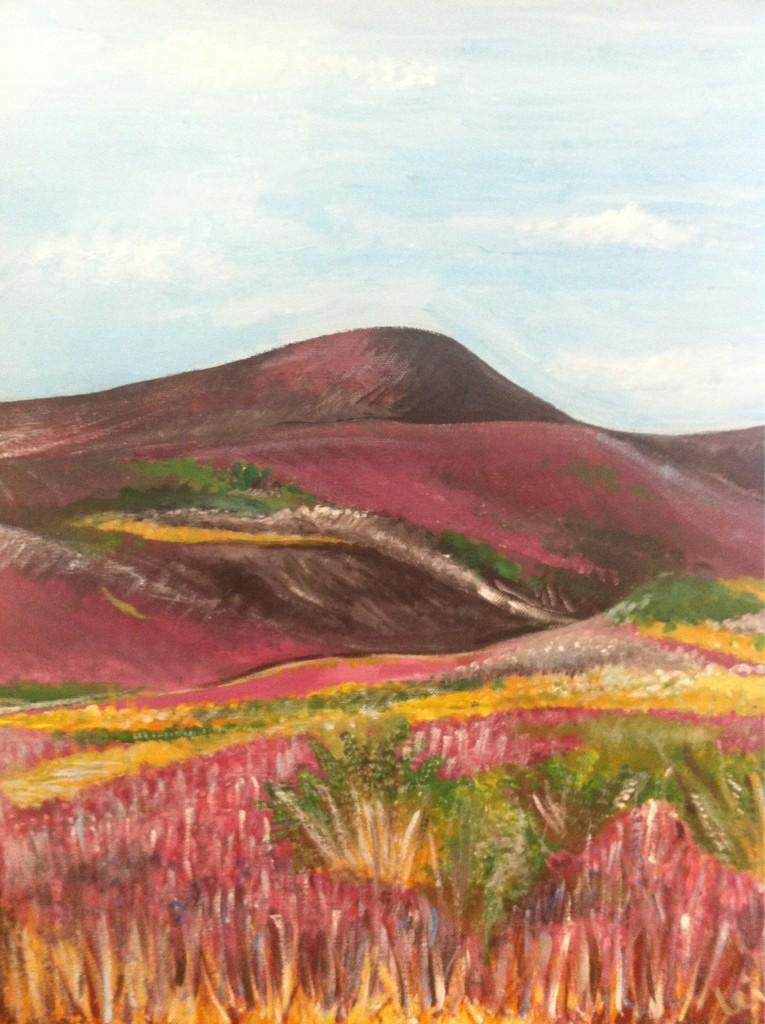
When I moved into my flat nine months ago, I took with me lots of paintings that I had done in the past, with the intention of putting them up somewhere.  Whilst I have done this with some of them, there was one that didn't seem to 'fit' in any room.
 
This was primarily because the sky in the picture was a really deep, vivid blue and the colours, in general, were quite bold.  The colours in my flat are quite subtle and subdued and it seemed garish in every room.
 
I had left it propped up  against the wall in my spare room and there it seemed destined to stay.  Until a conversation with a friend about it earlier on in the week, which drew my attention to it again.
 
We tried it out in each room, and it still didn't really 'go'.
 
Until yesterday morning, when I decided to repaint it.
 
It is still the same landscape and the same image.  But the sky is now a pale dusty blue and the harsh colours are softer.  The whole painting looks much gentler and calmer.
 
Before, it was dramatic and tense.  Now, it is peaceful and tranquil.
 
And it goes.
 
I was really pleased that I thought to repaint it, and I'm really pleased with the outcome.
 
And I found it really therapeutic, too, that idea of repainting the past.  The process of taking something old that didn't fit in any more, something which I didn't like as it was, and repainting it, making it new.
 
It is so easy to think that we are stuck with things that can't be changed: mistakes that we have made in the past, or lies that we believed, or people that we pretended to be.  We think that they are fixed and unchangeable.  But there is always the possibility of repainting the past.
 
The Bible says,
"God rewrote the text of my life
when I opened the book of my heart to his eyes."
         [Psalm 18:24 MSG]
 
 
I gave up a few hours to repaint the sky on a small canvas.  But God gave up His Son, so that anyone who wants to can be repainted too.
"This means that anyone who belongs to Christ has become a new person. The old life is gone; a new life has begun!"
 
[2 Corinthians 5:17 NIV] 


Saturday, 1 September 2012

Nature and Nurture

The thing I miss the most now that I live in a flat is not having a garden.

I have been to a garden centre today and am currently sitting outside in a garden, and have realised afresh how much I miss having one of my own.

I love sitting out in the sunshine (on those rare occasions it makes an appearance), reading and relaxing. I love the peace and quiet. I enjoy the beautiful scents of different flowers, the bright colours and delicate shapes of different plants. I love the soft feeling of grass beneath my feet and the sound of the breeze rustling in the trees.

And I love the fresh air.

I love being outside and it always feels good for you, yet I never feel I spend enough time in nature, in the great outdoors.

And this seems to be a common feeling: we long to spend time outside and yet we never feel we spend enough time out of doors. We feel somehow disconnected from nature.

Rob Bell writes,

"We're disconnected from the earth. And we know it. Or at least we can feel it, even if we don't have words for it [...]

Many people live in air-conditioned houses and apartments. We alter our air with electric machines. We spend vast sums of money and energy to change our air. And we drive in air-conditioned cars - the 8 percent of us in the world who have cars - to air-conditioned schools and offices and stores with tile floors and fluorescent lights.

It's even possible to go days without spending any significant time outside. And it's still considered living. It's easy to go for weeks and maybe even years without ever actually plunging your hands onto soil. Into earth. Into dirt."

What is it about nature that draws us to itself?

I think it offers us a place of restoration and peace. Time slows down and we feel that we can breathe again and be ourselves again. In the clamouring busyness of life, it is good to stop and slow down. Nature gives us a feeling of freedom and space: out in the wild, we are no longer confined by office walls, or car doors or deadlines and time constraints.

Nature nurtures us.  It soothes our souls and refreshes our spirits.

It is a safe and spacious place where we can be restored:

"He brought me out into a spacious place; he rescued me because he delighted in me."
[Psalm 18:19 NIV]

The Garden of Eden - whether we see it as a literal garden or a literary garden - tells of humanity's relationship with nature. It is a place of space and freedom, but it is also safe and secure and we have everything we need.

"The spacious, free life is from God, it's also protected and safe."
[Psalm 37:39 MSG]

We are living "east of Eden" in a world that is less than perfect, where we don't always feel safe and secure. Nature - and gardens in particular - remind us that we were made for more than office blocks and artificial lighting and air-conditioning. We were made for more than the fast-paced world of business. Gardens remind us to pause and reflect and remember that we were made for a free and spacious life.

For the time being, I am making do with my own small herb "garden" in my flat - a constant reminder to get out into creation and connect with our Creator.

Friday, 31 August 2012

The Edge of the Abyss

One of the paintings in the Munch exhibition yesterday by which I was mesmerised was called 'Girls on the Bridge'. 
 
Girls on the Bridge, 1899 by Edvard Munch
 
There are, in total, 12 different versions of this painting - it seems it was a theme and an idea to which he returned several times, each time capturing a slightly different aspect or angle of the subject.
 
Critics have formed different opinions and ideas about the painting and its meaning.  In particular, they have been mesmerised by the dark depths of the river swirling below the bridge and what it might represent.
 
Munch himself revealed some of the symbolism of the imagery in his paintings - especially the darkness - in the following quote:
"My whole life has been spent walking by the side of a bottomless chasm, jumping from stone to stone. Sometimes I try to leave my narrow path and join the swirling mainstream of life, but I always find myself drawn inexorably back towards the chasm's edge, and there I shall walk until the day I finally fall into the abyss."
Sometimes in life we can feel dangerously close to the edge of the abyss.  We can fear falling into the bottomless chasm and being unable to get out again.  We all go through periods where we feel 'down' and experience bouts of depression - some longer than others - and we just can't seem to lift ourselves out of our own pits.  We try to join the "swirling mainstream of life" but, like Munch, we feel lost in the chasm.  We question ourselves and our lives and our God.  And none of the answers we find seem to satisfy us.
 
When we are in these dark times, it is easy to feel that we won't ever find our way to the surface again.
 
We need someone else to rescue us - someone to reach down into the depths and pull us to the surface.
 
And this is exactly what God says He will do:
 
         "But me he caught—reached all the way
          from sky to sea; he pulled me out
          Of that ocean of hate, that enemy chaos,
          the void in which I was drowning.
          They hit me when I was down,
          but God stuck by me.
          He stood me up on a wide-open field;
          I stood there saved—surprised to be loved!"
 
          [Psalm 18:16-18 MSG]
 
Whilst we may find ourselves at the edge of the chasm, we will never be lost there forever: as soon as we cry out to God, He will always reach down and rescue us and bring us to the surface.